

Our lives develop in such a way that sometimes we have to go to doctors. Although we often criticize American medicine or insurance companies, you have to admit that our lives would not be as convenient without them. Especially without doctors who provide us with medical care of various levels of complexity for money or for free. So imagine how happy the residents of the Bronx were when the first hospital was opened in this borough of New York in the late nineteenth century. After all, they had the opportunity to receive qualified medical care. The first institution to appear in this area was Fordham Hospital. Find out more about the history and employees of this institution on bronx1.one.
History of the university
According to the nytimes, you may have noticed the similarity between the names of the hospital and the private educational institution Fordham University. The fact is that you are not mistaken as they are indeed related. This hospital was created based on the institution or, more precisely, for the institution, on its territory. That is why let us first tell you more about this innovative university (because, in our opinion, only advanced universities establish medical institutions for their own needs and for the population living nearby), and then about the hospital.
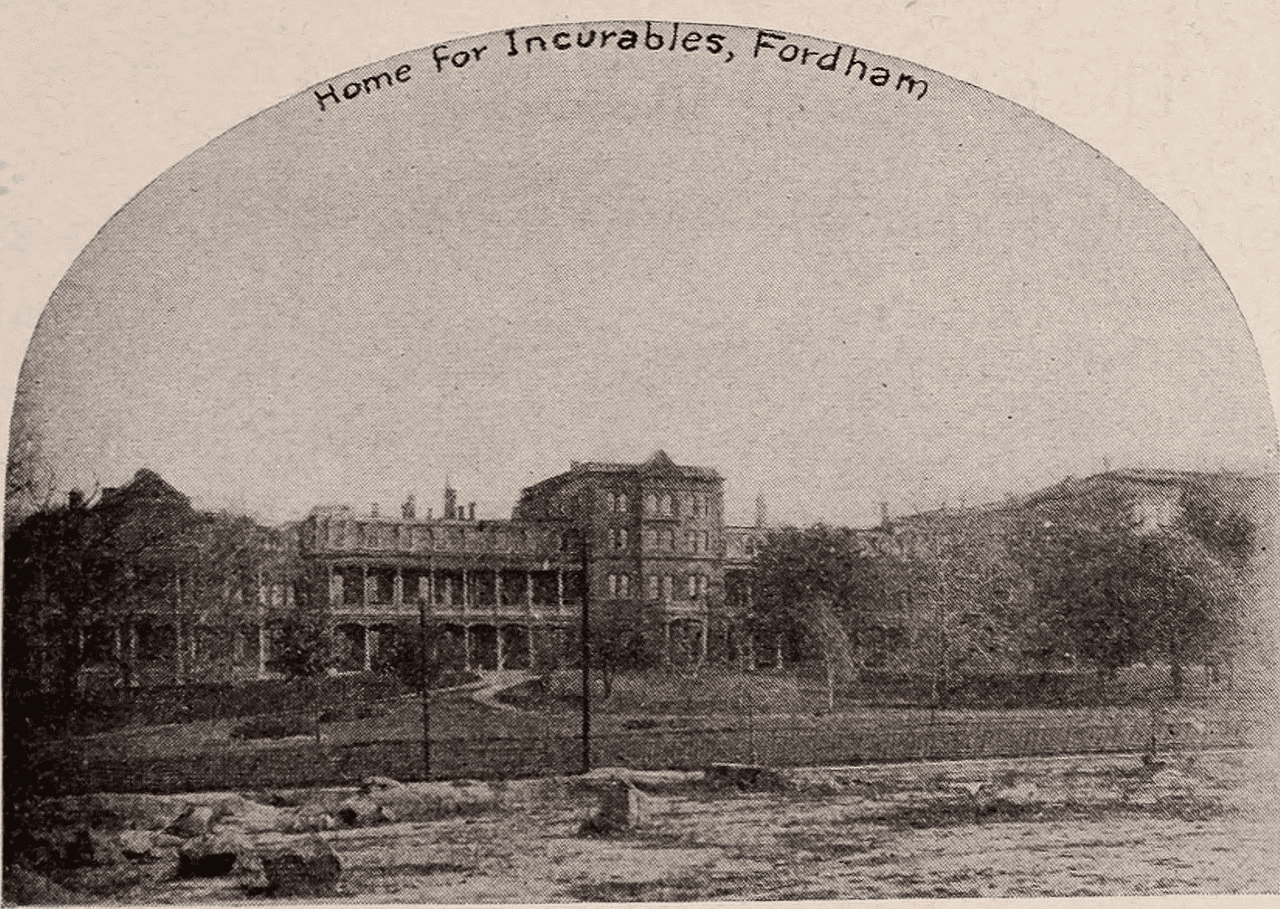
Fordham University was founded as St. John’s College in 1841. It was opened by Bishop John Hughes of the Diocese of New York. At the time the university was established here, it was one of the oldest in the state and the first higher education institution in the northeastern United States. The university was located in the Bronx, in an area called Fordham (then a small settlement near New York City). But back to our college.
In 1846, the college was sold to the Jesuit order: the rights to use it as an educational institution were transferred to the order’s representatives, but the land and property remained in the ownership of John Hughes. Since then, the college has begun to expand, and a new premise for teaching was built in Manhattan. The institution taught Latin, Greek, literature, history, religion, mathematics, geography, rhetoric and philosophy. Starting in 1859, the school had its own baseball team, which actively participated in various state competitions.
In 1904, the college opened the law and medical faculties. In 1907, the institution was officially granted the right to be called a university. Even earlier, in 1892, a hospital was opened here. We will tell you about it further.
Fordham Hospital
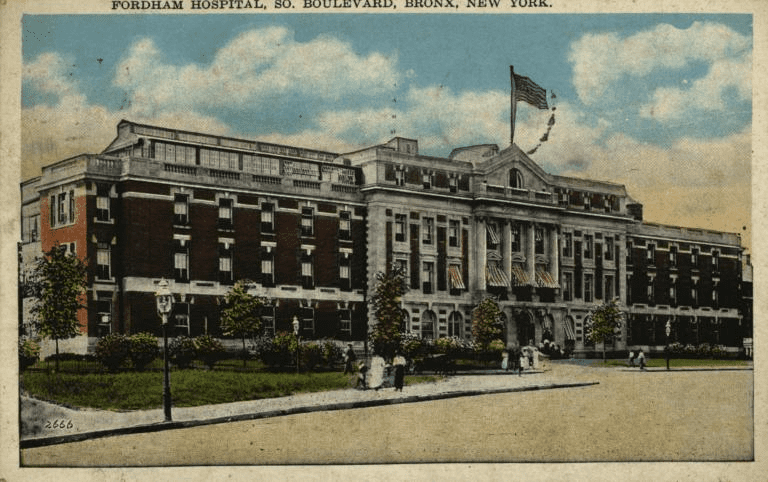
As already mentioned, Fordham Hospital was the first hospital in the Bronx (all the others were in Manhattan). It was built on Valentine Avenue near Kingsbridge Road. This was not a very convenient location for local residents, as it was far from residential areas, roads and generally in an undeveloped area. Therefore, over time (6 years later), the hospital moved to Aqueduct Avenue and was located on Saint James Square. At the time, it was a small medical facility that provided care to the local population. Over the following decades, the hospital evolved and transformed. In 1907, it changed its location again and moved to the intersection of South Boulevard and Croton Avenue. This meant that it was placed next to Fordham University. The hospital building was designed by architect Raymond F. Almirall (read more about him below).
The hospital and the university had joint management. In particular, the president of the hospital was also the dean of the university’s medical school. Students who studied medicine at this institution could continue their studies in internship.
In the 1930s, the hospital was given the opportunity to decorate its walls with artistic paintings at the expense of federal funds. That’s why artists Emily Newton Barto and Elizabeth Dearing decorated the walls of the medical institution with their works.
What did the hospital specialize in?
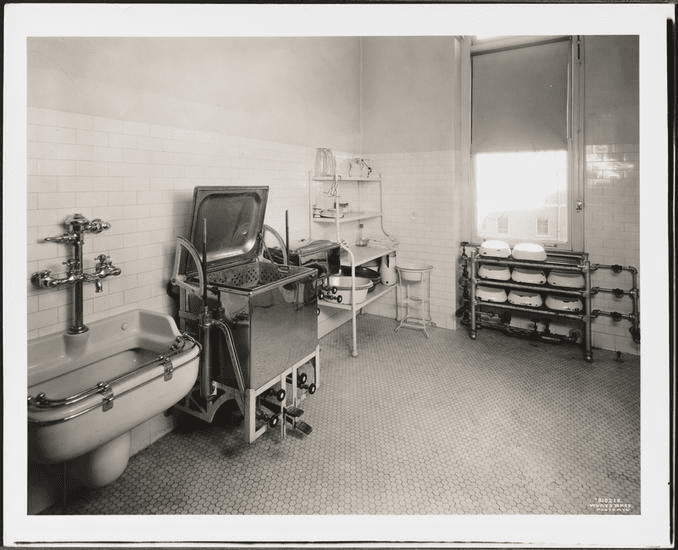
Fordham Hospital, as a multidisciplinary medical institution, provided treatment for various diseases and all patient conditions. In particular, there were departments for the treatment of heart and vascular diseases, oncology, pulmonology, gastroenterology, neurology and others. The hospital also had emergency departments to assist in case of injuries and various emergencies.
According to different sources, the number of employees working at Fordham Hospital ranged from 1,000 to 2,000 people. The medical staff included doctors, nurses, paramedics, laboratory technicians and other healthcare workers. After the hospital closed, they had the opportunity to find new jobs because they were warned in advance.
Raymond F. Almirall – hospital architect
Born in 1869 in New York City, Raymond F. Almirall studied architecture at Cornell University and the École des Beaux-Arts in Paris. Having created his own company with a partner and then working alone, Raymond F. Almirall has built more than 26 buildings in New York and abroad (a cathedral in Jamaica). All of his buildings were constructed using structural steel, reinforced concrete and reinforced concrete.
Fighting for the hospital
The hospital was able to operate for over 80 years. For a long time, it received complaints about its poor fire safety, low-quality anesthesia drugs and improper sterilization of instruments and materials. When the decision to close it was made, there were public protests. The authorities also supported its closure, as they considered Fordham to be an “outdated medical almshouse.”
It was planned to close Fordham Hospital and the old municipal hospital in Morrisania in order to build 2 new ones in their place or instead. However, during the negotiations between the Bronx community and city officials, it was agreed that only one hospital would be opened. It would be called the Bronx North Central Hospital. It would cost $94 million and be built next to Montefiore Hospital. The new hospital would have 412 beds. This means that the Bronx would not receive an adequate number of beds because the old hospitals had a total of 694 beds. Also, one of the problems with closing old hospitals and opening new ones is affiliation agreements, where hospitals can only serve certain patients or hire only nurses for a certain part of the Bronx. The same concerns were expressed by Catholic priests who used to play a significant role at Fordham University, and thus at the hospital.
All these problems were expressed by the public to the authorities. Thus, the latter had to negotiate with all stakeholders to ensure that the affiliation would continue to take place at Lincoln Hospital.
The closure of the hospital led to a serious deterioration in access to medical care for residents of the borough and became a subject of public debate for a long time. However, some of the hospital’s buildings have been converted to other uses, such as storage for archival documents and cultural centers.
Consequently, on July 15, 1976, the hospital was closed due to accusations of unsatisfactory performance. The hospital building was demolished and replaced by a parking lot for the university.